

Study in Canada
Studying in Canada offers more than just academic excellence; it provides a pathway to a promising career and a fulfilling life. With globally recognized institutions, diverse cultural experiences, and abundant post-graduation opportunities, Canada stands out as a top choice for international students.
Discover Why Canada is a Top Choice for International Students
30 Top-Ranked Universities | High Employability | Affordable Tuition – Canada is Your Path to Success!
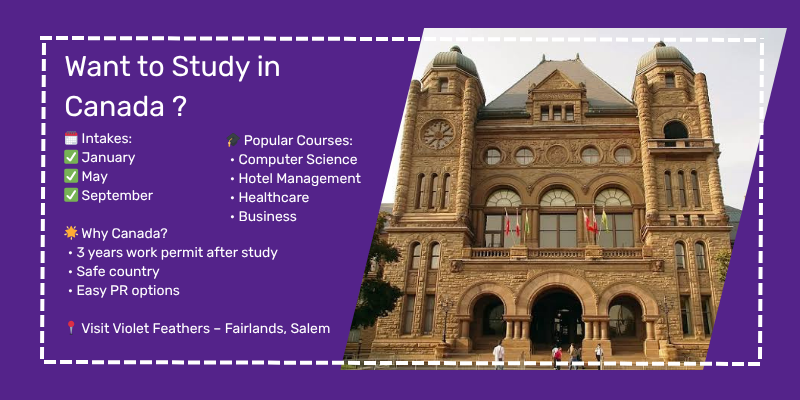
 Why Choose Canada?
 Why Choose Canada?
Canada has become a preferred destination for students worldwide, offering a blend of high-quality education, cultural diversity, and promising career prospects. Here’s why:
🎓 1. World-Class Education
Canadian universities are globally recognized for their academic excellence. Institutions like the University of Toronto and McGill University consistently rank among the top 100 worldwide, offering diverse programs across various disciplines.
🌍 2. Cultural Diversity
Canada prides itself on being a multicultural society, welcoming students from all corners of the globe. This diversity enriches the educational experience, allowing students to learn from each other’s perspectives and fostering a global community.
💼 3. Work Opportunities
International students in Canada can work part-time during their studies and full-time during scheduled breaks, providing valuable work experience and financial support. Additionally, the Post-Graduation Work Permit Program allows graduates to gain Canadian work experience, which can be a pathway to permanent residency.
💰 4. Affordable Education
Compared to other popular study destinations like the U.S. and the U.K., Canada offers competitive tuition fees and living costs. Scholarships and financial aid options further make education accessible to international students.
🛡️ 5. Safe and Welcoming Environment
Canada is consistently ranked as one of the safest countries globally. Its inclusive society ensures that international students feel at home, with support systems in place to help them thrive academically and socially. IDP
🌿 6. High Quality of Life
With excellent healthcare, clean cities, and a strong emphasis on work-life balance, Canada offers a high standard of living. Students can enjoy a comfortable lifestyle while pursuing their studies.
🏞️ 7. Natural Beauty
Canada boasts stunning natural landscapes, from the Rocky Mountains to pristine lakes and forests. Students have ample opportunities to explore the outdoors and engage in various recreational activities.
🇨🇦 Canada Study Permit & Work Permit Latest Updates
🎓 1. Study Permit Cap Reduced
Canada has set a cap of 437,000 study permits for 2025 and 2026, down from 485,000 in 2024. This includes graduate students (master’s and doctoral), who were previously exempt from the cap. Applicants for these programs must now submit a provincial or territorial attestation letter as part of their study permit application.
📈 2. Increased Financial Requirement
As of January 1, 2024, international students must demonstrate access to CAD 20,635 to meet the new cost-of-living requirement, up from CAD 10,000. This adjustment aims to help students manage the rising living costs in Canada.
🕒 3. Off-Campus Work Hours Increased
Starting November 2024, international students can work up to 24 hours per week off-campus during academic sessions, an increase from the previous 20-hour limit. This change allows students to gain more work experience while maintaining a balance between their academic and professional responsibilities.
🛂 4. End of Flagpoling for PGWP Applications
As of June 21, 2024, international students can no longer apply for a Post-Graduation Work Permit (PGWP) at Canadian border entry points, a process known as flagpoling. All PGWP applications must now be submitted online or through authorized immigration offices within Canada.
💼 5. Spousal Work Permit Eligibility Limited
Starting 2024, only spouses of international students enrolled in master’s programs lasting at least 16 months qualify for a Spousal Open Work Permit (SOWP). This restriction aims to better manage work permits and ensure they align with long-term academic programs.
📝 6. Study Permit Required for Changing Institutions
Effective November 8, 2024, international students wishing to change their post-secondary institution must apply for a new study permit instead of simply notifying Immigration, Refugees, and Citizenship Canada (IRCC). This ensures compliance with Canada’s immigration rules and reinforces the importance of maintaining student compliance reporting with Designated Learning Institutions (DLIs).
🧠 7. Enhanced Mental Health Support
Starting in 2025, all DLIs must provide access to tailored counseling services for international students. Mandatory orientation sessions on mental health resources are now required for new students. These initiatives reflect Canada’s commitment to supporting the overall well-being of its international student population.
Cost of studying in Canada:
Certainly! Here’s an updated breakdown of the costs associated with studying in Canada for international students in 2025:
🎓 Tuition Fees (Annual)
Tuition fees in Canada vary based on the program and institution:
Undergraduate Programs: Approximately CAD 18,000 to CAD 40,000 per year.
Postgraduate Programs: Typically CAD 12,000 to CAD 30,000 annually.
MBA Programs: Range from CAD 30,000 to CAD 60,000 per year.
Engineering & Science Programs: Between CAD 18,000 and CAD 30,000 annually.
Social Sciences & Humanities: Approximately CAD 15,000 to CAD 25,000 per year.
Additional costs may include application fees (CAD 100–250), student service fees (CAD 500–1,000), and health insurance (CAD 600–1,000).
🏠 Living Expenses (Monthly)
Living costs depend on the city and lifestyle:
Accommodation:
On-campus: CAD 400–1,500
Off-campus/shared: CAD 600–2,000
Food: CAD 200–400
Transportation: CAD 80–150
Utilities & Internet: CAD 50–150
Entertainment & Miscellaneous: CAD 100–300
Overall, monthly living expenses range from CAD 1,225 to CAD 3,136, depending on location and lifestyle.
💰 Proof of Financial Support
As of January 1, 2024, international students must demonstrate access to at least CAD 20,635, in addition to tuition and travel expenses, to prove sufficient funds for living costs.
🛂 Additional Costs
Study Permit Application Fee: CAD 150
Health Insurance: CAD 600–900 annually
Airfare: Approximately CAD 1,800
Textbooks & Supplies: CAD 800–1,500 per year
📊 Sample Annual Budget (in CAD)
| Category | Estimated Cost (CAD) |
|---|---|
| Tuition Fees | 18,000 – 60,000 |
| Living Expenses | 14,700 – 37,632 |
| Health Insurance | 600 – 900 |
| Study Permit | 150 |
| Airfare | 1,800 |
| Textbooks & Supplies | 800 – 1,500 |
| Total | 35,050 – 101,982 |
Note: Exchange rates may vary; the above estimates are based on current rates.
🇨🇦 Top Canadian Universities in 2025
| Rank | University | QS World Rank 2025 | THE World Rank 2025 | City |
|---|---|---|---|---|
| 1 | University of Toronto | 25 | 21 | Toronto, ON |
| 2 | McGill University | 29 | 45 | Montreal, QC |
| 3 | University of British Columbia (UBC) | 38 | 41 | Vancouver, BC |
| 4 | University of Alberta | 96 | 116 | Edmonton, AB |
| 5 | University of Waterloo | 115 | 163 | Waterloo, ON |
| 6 | Western University | 120 | 201–250 | London, ON |
| 7 | Université de Montréal | 159 | 125 | Montreal, QC |
| 8 | McMaster University | 176 | 116 | Hamilton, ON |
| 9 | University of Ottawa | 189 | 191 | Ottawa, ON |
| 10 | Queen’s University at Kingston | 193 | 301–350 | Kingston, ON |
Note: Rankings are subject to change and may vary based on different ranking methodologies and criteria.
🏦💵 Secure your future with an education loan
Partnering with Leading Student Loan Providers for Your Educational Journey We collaborate with top-tier financial institutions to offer flexible and tailored financing solutions, ensuring you have the support needed to pursue your academic aspirations confidently.
Get FREE Counselling Today!
Share your details, and our expert will contact you to discuss your plans. All services are free!