
Study in the USA
Studying in the USA offers a world-class education, access to diverse academic programs, and the chance to immerse yourself in a dynamic, multicultural environment. Here’s a short overview:
Discover why Indian students are drawn to studying in the USA
Indian students flock to the USA for a range of compelling reasons—from world-class academics to vibrant cultural experiences and unbeatable career prospects.
10 of the World’s Top 20 Universities | 4,000+ Institutions | Leading in Research & Innovation | Strong Employability – The U.S.: Your Launchpad to Global Success!
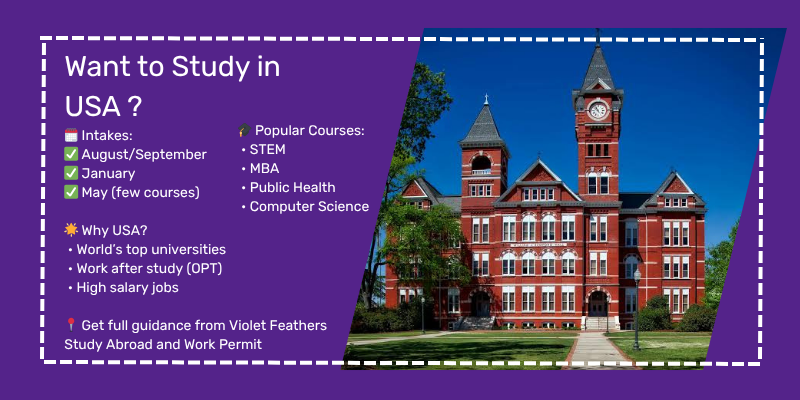
 Why Study in the USA?
 Why Study in the USA?
Studying in the USA is an incredible opportunity for international students, and here’s why:
🌟 1. World-Class Education
The USA is home to some of the most prestigious universities in the world, including Harvard, MIT, Stanford, and Yale. These institutions are known for their academic rigor, cutting-edge research, and global influence. Whether you’re interested in STEM fields, business, art, or humanities, U.S. universities offer top-tier programs across almost every discipline.
🌎 2. Global Recognition of Degrees
A degree from a U.S. institution is recognized and highly respected worldwide. U.S. universities consistently rank among the best in global rankings (QS, Times Higher Education), ensuring that a degree from a U.S. school opens doors to career opportunities around the globe.
🏫 3. Diverse Academic Options
The U.S. offers an unmatched variety of academic programs and disciplines. You can find specialized degrees, double majors, and interdisciplinary courses tailored to your interests. Whether you’re looking for a liberal arts education, a research-driven program, or a practical skill-based degree, U.S. institutions give you flexibility to choose what best fits your goals.
🎓 4. Cutting-Edge Research and Innovation
U.S. universities are at the forefront of research and innovation. If you’re interested in groundbreaking research, the U.S. is the place to be. Many universities have state-of-the-art facilities, labs, and centers dedicated to everything from AI to medicine, engineering, and sustainable development. You’ll have the chance to collaborate with world-renowned professors and experts.
🌍 5. Cultural Diversity
The U.S. is a melting pot of cultures, with students and faculty from every corner of the globe. Studying in the U.S. offers a chance to interact with people from diverse cultural backgrounds, which helps expand your global perspective and enriches your experience.
💼 6. Strong Career Opportunities
Studying in the U.S. gives you access to an immense job market, especially in fields like technology, finance, engineering, and business. The Optional Practical Training (OPT) program allows international students to work in the U.S. after graduation for up to 12 months (or longer for STEM graduates). This provides valuable work experience, networking opportunities, and a potential pathway to long-term employment.
🏙️ 7. Vibrant Campus Life
U.S. universities offer vibrant student life, with countless opportunities for personal growth. From sports and clubs to volunteer work and social events, there’s always something happening. The campus culture in the U.S. promotes a strong sense of community, leadership, and teamwork.
💡 8. Opportunities for Networking
The U.S. has a vast network of alumni, industries, and institutions that students can tap into. Many universities have strong ties with leading global companies, making it easier to gain internships, work placements, and even full-time employment after graduation.
🌐 9. Flexible Visa Options
The U.S. offers flexible visa options for international students, with the F-1 student visa allowing you to study and work part-time on campus. Additionally, the OPT program allows you to stay and work after your studies to gain practical experience in your field.
💰 10. Financial Aid and Scholarships
Though tuition can be high, U.S. universities offer various forms of financial aid, including scholarships, grants, and assistantships. Many schools offer need-based or merit-based financial aid, and international students can apply for these to help offset costs. Additionally, on-campus jobs can help cover living expenses.
🔑 Conclusion
The USA offers an unparalleled educational experience, blending high-quality academics, cultural diversity, innovative research, and career opportunities. Whether you’re looking for academic excellence, professional development, or a transformative personal experience, studying in the U.S. is a gateway to achieving your goals.
Would you like to know more about specific universities, programs, or visa processes for studying in the U.S.? Feel free to ask!
Latest Updates for Studying and Working in USA (2025)
As of 2025, the USA remains a top destination for international students, offering world-class education, diverse cultural experiences, and strong post-graduation work opportunities. However, some important changes and updates regarding studying and working in the U.S. have occurred. Here’s a comprehensive look at the latest trends and policies:
📚 1. Visa and Immigration Updates
F-1 Visa: The F-1 student visa remains the primary option for international students wishing to study in the U.S. In 2025, the process continues to be streamlined for many applicants, but the overall approval process can take time. Be sure to apply well in advance and ensure your application is complete.
OPT (Optional Practical Training) and STEM Extension:
OPT allows international students to work in the U.S. after completing their degree, typically for up to 12 months.
For students in STEM fields (Science, Technology, Engineering, and Mathematics), the OPT extension is available for an additional 24 months (totaling 3 years), giving these graduates more time to gain practical work experience.
Application Window for OPT: Students can apply for OPT up to 90 days before completing their studies and up to 60 days after graduation. However, applicants must make sure their Form I-20 is updated.
New Work Visa Rules for International Students:
The H-1B visa process, which allows U.S. companies to employ foreign workers in specialized fields, has become more competitive and restricted in recent years. However, international students with a U.S. degree still have a strong chance of securing an H-1B visa, especially in fields like technology, engineering, and healthcare.
There’s been a push for reforms to make it easier for international students to transition from student visas to work visas.
Changes in Student Visa Duration:
J-1 Exchange Visa: In 2025, new programs under the J-1 Exchange Visitor Visa are being introduced, including more support for work-study programs, allowing students to gain professional experience while studying.
💼 2. Post-Graduation Work Opportunities
Optional Practical Training (OPT) remains a vital post-graduation work option for international students. As mentioned, students with a degree in a STEM field can extend OPT for an additional 24 months, but students in non-STEM fields are limited to the standard 12-month OPT period.
Cap-Gap Extension: For students who are on F-1 visas and applying for the H-1B visa, there’s a Cap-Gap extension. This allows students to continue working in the U.S. while their H-1B application is pending (if their application is selected in the lottery).
Wages for International Graduates: Many international students who graduate with degrees in high-demand fields (especially STEM) are seeing a rise in salaries, with starting wages in tech, engineering, and healthcare sectors reaching $80,000 to $120,000.
🏫 3. Financial Aid & Scholarships
Increased Financial Aid for International Students:
More U.S. universities are offering financial aid to international students, with an increasing number of need-based and merit-based scholarships available. Students can apply for both university-specific scholarships and external funding options.
Some universities are expanding their scholarships for international students in emerging fields like artificial intelligence, climate change, and global health.
Work-Study Programs: The U.S. continues to encourage international students to work part-time while studying. On-campus jobs are available for international students on F-1 visas, which allow you to work up to 20 hours per week during the semester and full-time during breaks.
🌍 4. New Online and Hybrid Learning Models
Growth in Hybrid Programs: With the ongoing trend of hybrid learning, many U.S. universities have shifted to offer more blended learning models, combining online and on-campus classes. This offers flexibility for students, especially in graduate programs and part-time study options.
Online Degrees: Many U.S. institutions now offer fully accredited online degrees. While this can be a flexible option for students already in the U.S., international students may face restrictions on obtaining visas for entirely online programs.
Post-Pandemic Adjustments: While most U.S. universities have returned to in-person instruction, some universities still offer remote learning options for specific programs, particularly in fields that require practical hands-on training or access to labs.
🌱 5. Sustainability & Green Initiatives
Focus on Sustainability: Many universities are adopting green initiatives and integrating sustainability into their curriculums. This includes environmental science, renewable energy, and sustainable business practices. International students interested in environmental studies will find plenty of opportunities in U.S. universities’ growing sustainability programs.
Campus Sustainability: Several campuses are becoming more eco-friendly, investing in renewable energy, recycling programs, and green architecture. This is in line with both student demand and the U.S. government’s push for carbon neutrality by 2050.
🌐 6. International Student Population Trends
Increased Diversity in U.S. Universities: The international student population in the U.S. is becoming increasingly diverse, with growing numbers of students from India, China, Brazil, and sub-Saharan Africa. The cultural diversity on U.S. campuses is contributing to a more inclusive and global academic environment.
Post-COVID Trends: After the pandemic, the U.S. has seen a strong recovery in international student enrollment, especially for students pursuing graduate degrees. Many international students are now seeking to study in the U.S. due to the combination of high-quality education and post-graduation work opportunities.
🛡️ 7. Safety and Wellbeing
Student Wellbeing Programs: U.S. universities are placing more emphasis on student mental health and wellbeing. With an increasing number of international students, many schools have implemented additional support systems like counseling services, peer support networks, and wellness programs to help students adjust to academic and social life.
Campus Security: U.S. campuses are considered safe, and most universities offer 24/7 security, campus police, and emergency services. Many also have international student offices that provide additional guidance on adjusting to life in the U.S.
🧑💻 8. Tech and Innovation Hub
Silicon Valley & Tech Opportunities: For those in tech, engineering, and entrepreneurship, the U.S. remains the global hub for innovation. Universities like Stanford, MIT, and UC Berkeley continue to produce cutting-edge research and provide students access to major companies in Silicon Valley.
Start-up Ecosystem: Many U.S. cities have thriving start-up ecosystems, with universities supporting students through incubators, accelerators, and entrepreneurial networks. This is a great opportunity for students who want to launch their own businesses after graduation.
Conclusion
The USA remains one of the most desirable destinations for international students in 2025. With updated visa policies, expanding opportunities for post-graduation work, flexible study options, and a global network of academic excellence, the U.S. continues to offer unparalleled opportunities for academic and professional growth.
Cost of studying in USA:
🎓 1. Tuition & Fees
Undergraduate: $20,000–$50,000 per year (public/private)
Graduate (Master’s/PhD): $20,000–$60,000 per year
MBA: $40,000–$80,000+ annually
🏠 2. Accommodation
On-campus: $8,000–$15,000 per year
Off-campus/shared: $6,000–$18,000 per year (or $500–$2,500+ per month)
🍎 3. Food & Groceries
Monthly groceries: $200–$600
Dining plans / eating out: Equivalent to $3,000–$6,000 annually
🚇 4. Transportation
Public transit: $50–$150 per month
Owning a car (insurance, fuel, maintenance): $200–$400/month
🏥 5. Health Insurance
Typically costs $1,000–$3,500 per year
📚 6. Books & Study Supplies
Annual cost: $500–$1,200
✈️ 7. Visa & Travel
F‑1 visa + SEVIS fees: $535 total
Round-trip airfare (India ↔ USA): $800–$2,000
🛍️ 8. Personal & Miscellaneous
Clothing, entertainment, phone/internet, etc.: $1,000–$4,000 per year (~$100–$300/month)
📊 Total Estimated Cost
| Location Type | Living Cost per Year | Plus Tuition (approx.) |
|---|---|---|
| Smaller towns | $8,000–$12,000 | + $20k–$50k |
| Major cities | $15,000–$25,000 | + $30k–$60k |
Overall annual cost often lies between $38,000–$85,000+, depending on study level, location, and lifestyle
🧭 Hidden / Additional Costs
International students often encounter extra costs such as:
Accommodation deposits
Exchange rate fees
Join fees for clubs or events
Healthcare services beyond insurance
“Health Insurance… Visa and Application Fees… Accommodation Deposits… Textbooks and Supplies… Transportation Costs… Social Activities… Currency Exchange Fees.”
✅ Cost-Saving Strategies
Apply for scholarships, assistantships, merit-based aid
Consider public universities in smaller cities
Cook meals and share housing
Get on-campus jobs (20 hrs/week limit) to offset expenses
🇺🇸Top USA Universities in 2025
Here’s a table of the Top U.S. Universities in 2025, based on academic reputation, research output, and overall global rankings:
| University | Location | Global Rank (2025) | Specialties |
|---|---|---|---|
| Harvard University | Cambridge, Massachusetts | 1 – 2 | Business, Law, Medicine, Social Sciences, Engineering, Humanities |
| Massachusetts Institute of Technology (MIT) | Cambridge, Massachusetts | 1 – 2 | Engineering, Computer Science, AI, Robotics, Business, Economics |
| Stanford University | Stanford, California | 2 – 3 | Engineering, Computer Science, Business, Physics, Social Sciences |
| California Institute of Technology (Caltech) | Pasadena, California | 3 – 4 | Engineering, Physics, Earth Sciences, Chemistry, Computer Science |
| University of Chicago | Chicago, Illinois | 5 | Economics, Business, Law, Social Sciences, Medicine |
| Princeton University | Princeton, New Jersey | 6 | Mathematics, Physics, Economics, Engineering, Humanities |
| Columbia University | New York, New York | 7 | Business, Law, Social Sciences, Humanities, Engineering |
| Yale University | New Haven, Connecticut | 8 | Law, Humanities, Social Sciences, Medicine, Environmental Studies |
| University of California, Berkeley | Berkeley, California | 9 | Engineering, Computer Science, Business, Environmental Science, Chemistry |
| University of California, Los Angeles (UCLA) | Los Angeles, California | 10 | Arts, Social Sciences, Engineering, Business, Life Sciences |
| University of Pennsylvania | Philadelphia, Pennsylvania | 12 | Business, Law, Social Sciences, Engineering, Medicine |
| Cornell University | Ithaca, New York | 15 | Engineering, Business, Agriculture, Social Sciences, Biology |
| Johns Hopkins University | Baltimore, Maryland | 18 | Medicine, Public Health, Engineering, Biomedical Research |
| University of Michigan, Ann Arbor | Ann Arbor, Michigan | 20 | Engineering, Business, Social Sciences, Law, Life Sciences |
| Duke University | Durham, North Carolina | 25 | Medicine, Engineering, Business, Law, Public Policy |
| Northwestern University | Evanston, Illinois | 30 | Journalism, Business, Engineering, Social Sciences, Communications |
| University of California, San Diego (UCSD) | San Diego, California | 35 | Oceanography, Biology, Engineering, Computer Science |
| University of Southern California (USC) | Los Angeles, California | 40 | Film, Engineering, Business, Arts, Social Sciences |
| Brown University | Providence, Rhode Island | 45 | Humanities, Social Sciences, Public Health, Biology |
| University of Washington | Seattle, Washington | 50 | Computer Science, Engineering, Business, Medicine |
Key Insights:
Top 5 Universities: The Ivy League schools—Harvard, MIT, and Stanford—continue to dominate the global rankings due to their prestigious programs and research contributions, especially in areas like engineering, business, medicine, and social sciences.
Public Universities with Strong Programs: The University of California campuses, including UC Berkeley, UCLA, and UCSD, are consistently ranked highly for their engineering, business, and social sciences programs.
Specialization: Many universities specialize in certain fields, such as Johns Hopkins for medicine and public health, or Northwestern for journalism and communications.
🏦💵 Secure your future with an education loan
Partnering with Leading Student Loan Providers for Your Educational Journey We collaborate with top-tier financial institutions to offer flexible and tailored financing solutions, ensuring you have the support needed to pursue your academic aspirations confidently.
Get FREE Counselling Today!
Share your details, and our expert will contact you to discuss your plans. All services are free!